
A platform that achieves stable supply and the passing on of skills
The declining and aging farming population is now a problem. The farming population fell to a third between 1985 and 2015, and about half are 65 or older (*). In recent years, unseasonable weather has also repeatedly reduced crop supplies, and restaurants and food manufacturers increasingly need a stable supply.
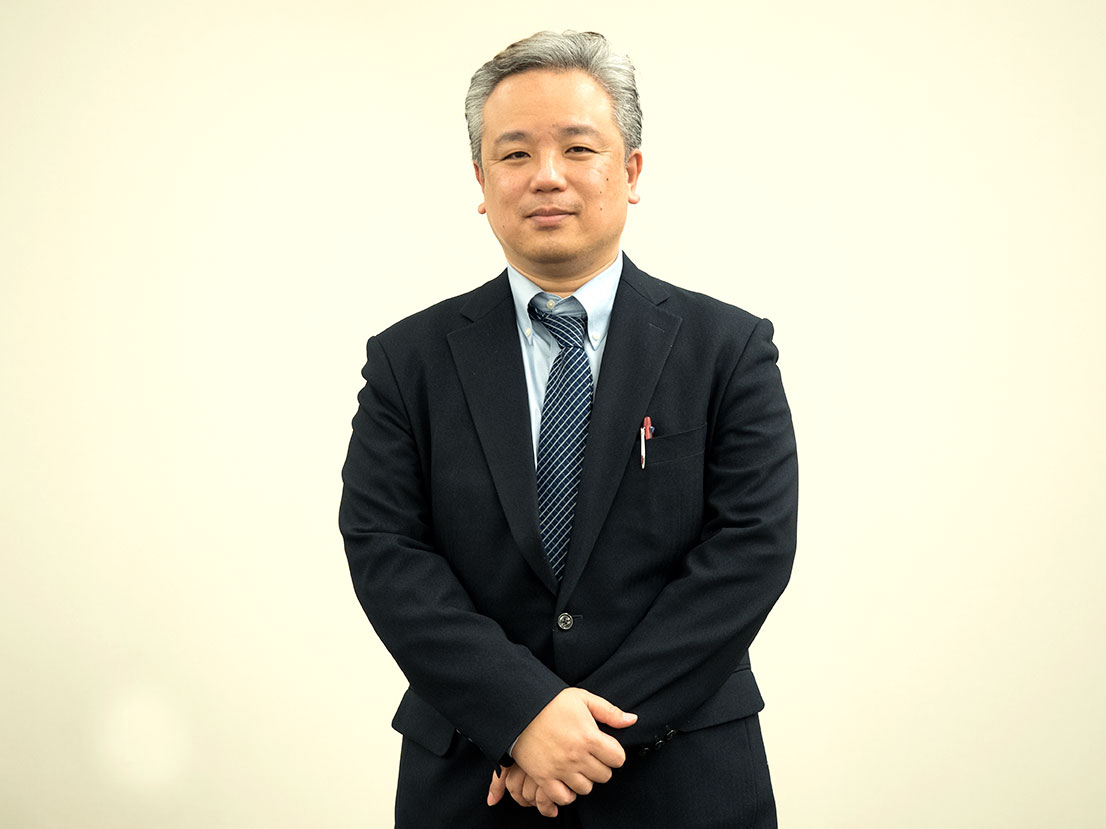
Against this background, ASP Co., Ltd. was founded on February 26, 2018. It runs businesses that make up an Agri Stable Supply Platform. We spoke with President and Representative Director Naoki Hayashi about the business and how the company was founded.
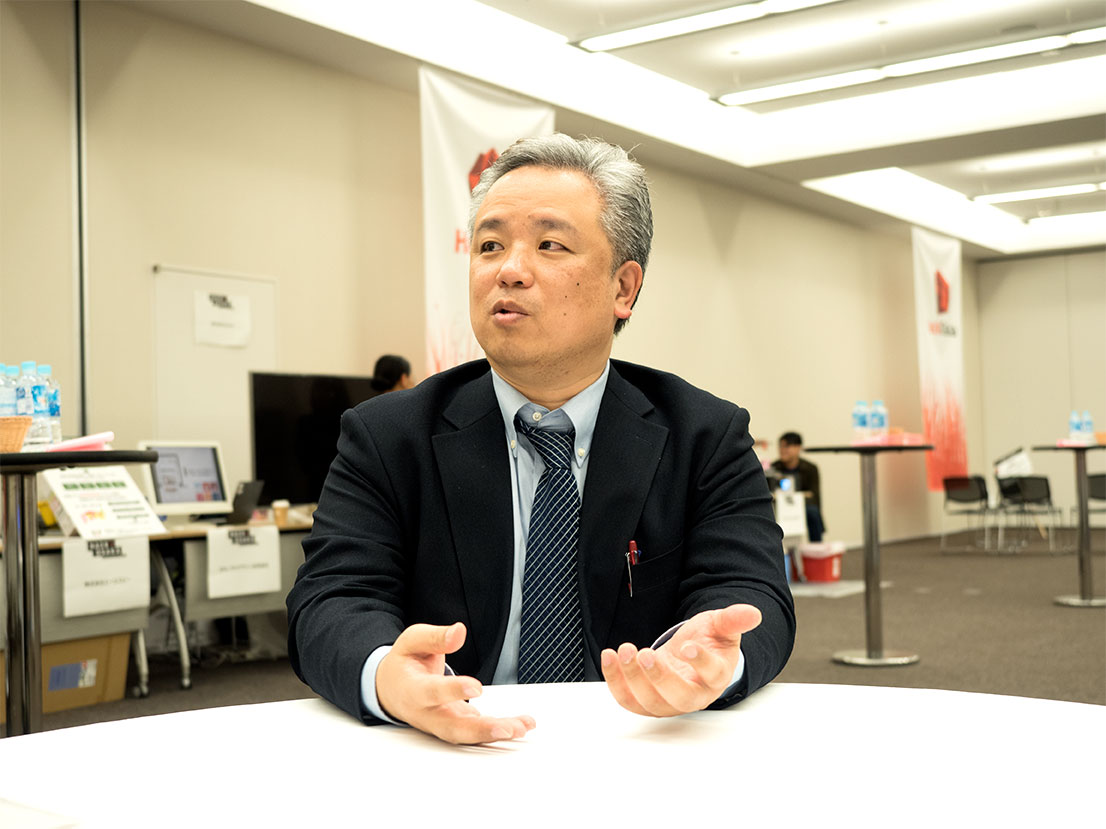
ASP mainly provides participating producers with know-how for a stable supply of crops and for raising each farmer’s yield and income.
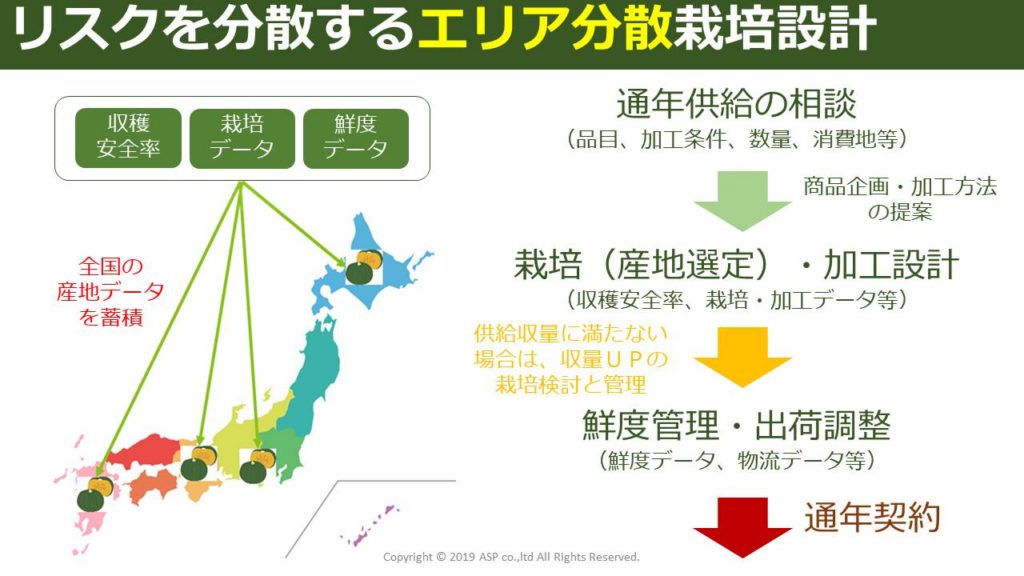
One example is the “Year-Round Stable Supply Service,” which manages cultivation spread across areas. Spreading the areas where crops are grown eases the impact of unseasonable weather. The company also hears supply specifications (crop items, quantities, processing, and so on) from restaurants and food manufacturers, forms a platform of producers across Japan (growers, shippers, and processors), and designs everything from cultivation to processing to distribution as a whole, achieving a stable supply of raw materials.
The region-specific “Cultivation Skill Transfer Service” is also highly original. It makes visible the know-how of experienced farmers who grow organically with high yields per unit area and good quality, and provides it to young farmers and newcomers to support their farm management.
Specifically, the company goes to experienced farmers’ fields and senses environmental data such as temperature, humidity, and soil. It also interviews farmers about their cultivation know-how and turns it into data. Work that is hard to put into words is filmed on video. Working with universities in Kansai, it aims to standardize cultivation processes through big data analysis using AI. Going forward, it plans to use smartphone apps, wearable devices, and IoT equipment so that farmers can receive remote management and farm work guidance.
The company also signs purchase contracts with farmers who adopt the service. Because it buys all their crops, farmers’ income stabilizes, and manufacturers’ supply stabilizes. Meanwhile, farmers who provide their cultivation skills receive incentives in return, protecting their intellectual property. “Until now, farmers could only earn income from their own fields, but now income also comes in from the places their know-how is transplanted to. Think of it as the fields you manage increasing,” says Hayashi. It is a service that benefits both those who provide the skills and those who receive them.
Growing the crops people want grown, and preserving experienced farmers’ 30 years for future generations
Hayashi graduated from the Faculty of Agriculture at Osaka Prefecture University. After graduating, Hayashi joined Riken Vitamin Co., Ltd. and worked on food development. Hayashi felt the need for a stable supply of crops while working in industrial promotion. While matching producers with buyers to support their sales, food manufacturers said, “Supply is unstable because of unseasonable weather,” and producers said, “What we produce is hard to sell.” Hearing both sides, Hayashi thought, “Let’s start a business that grows what people want grown, rather than selling what has been grown.” That led to the Year-Round Stable Supply Service. Hayashi took it to the Challenge IoT Award 2017 and won the ICT Business Study Group Grand Prize in March 2018.
Around the same time, Hayashi started the Cultivation Skill Transfer Service. It began with meeting an experienced farmer who has grown organic lemons for about 30 years in Kinokawa City, Wakayama Prefecture. Research showed that the yield per tree was about three times higher than in the main producing areas of Hiroshima and Ehime Prefectures. “There was no successor, and if nothing changed, the know-how built up over 30 years would be lost. Wanting to somehow pass on the skills was also what led me to come up with the service.” With this service, Hayashi won the OIH Award at Mirainno Pitch 2018.
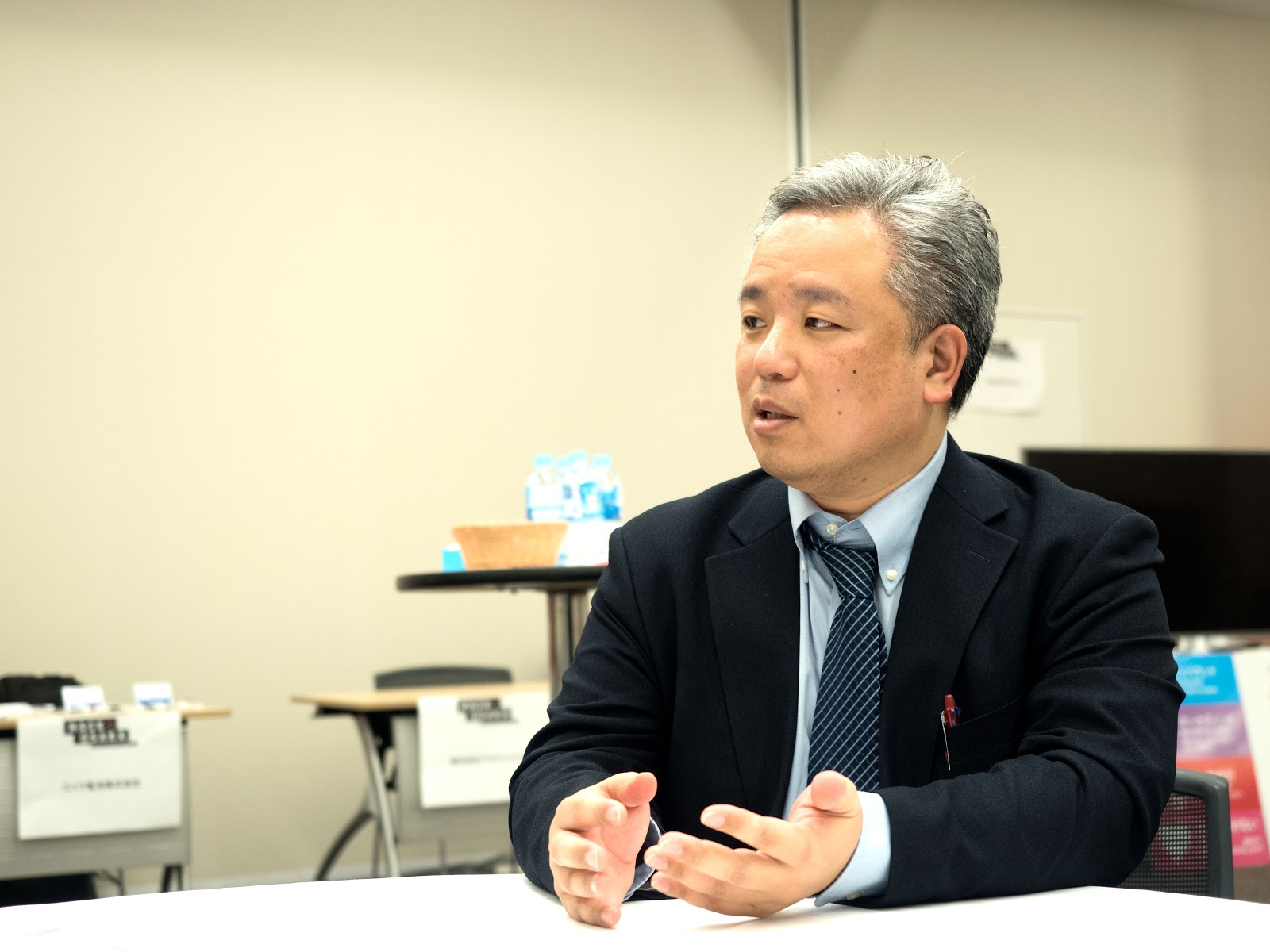
Having originally worked in industrial promotion, Hayashi had encountered AI and IoT developed by venture companies. Some could be used in farming and distribution processes, and Hayashi is considering bringing the latest technology into the service.
More companies are combining agriculture and IT, but Hayashi says, “We don’t intend to compete with anyone.” “What we aim for is a stable food supply and raising the status of producers. We join hands with people who share that and work together to achieve the goal.” Cooperating with people facing the same direction, the company has in fact built a network of more than 600 producers across Japan.
Making everyone in Japan a producer, taking on the agricultural industry from many angles
ASP aims not only for a stable food supply but also to increase the farming population. But the hurdles to starting farming are high. So one of its goals is “making everyone in Japan a producer.” Hayashi explains that farming can be divided into several processes, such as watering, thinning fruit, and harvesting.
“It is hard for one person to do all the work, but if there were a system that let people take part in each task, the burden on farmers would drop and farming would become much more familiar.” The company is also looking at “agriculture-welfare cooperation”: by taking part in some tasks, people with disabilities can find work, and workcations that also refresh body and mind can be developed. In fact, at the request of Wakayama Prefecture, the company is considering bringing agriculture-welfare cooperation into sansho pepper cultivation.
Going forward, the company will put its Agri Stable Supply Platform into full operation. For example, lemon cultivation is also being carried out in Shirahama Town, Wakayama Prefecture. Because lemons are easier to grow in warm conditions, the company uses heat from the local Tsubaki Onsen hot spring for cultivation. It is also looking to expand to other crops, such as producing Kyoto-grown wasabi and branding it for overseas markets.
Another focus is an “Inbound Visitor Promotion Service.” One challenge regions face is that there is no system for foreign tourists to spend money locally when they visit. So the company aims to carry out, within the Agri Stable Supply Platform, a system for local production for local consumption, from growing local ingredients to product development, promotion, and bringing in tourists.
In the future, Hayashi says, “I want to make Japanese agriculture the world’s No. 1 job people want to do.” Beyond lowering the hurdles to starting farming, Hayashi also wants to change its image to one that is “cool” and “stylish.” Hayashi also sees room for growth: “Agriculture has the potential to expand in many directions.” The challenge of this innovator, taking on the agricultural industry from many angles, has only just begun.
*Source:
Ministry of Agriculture, Forestry and Fisheries (2017), “FY2016 Annual Report on Food, Agriculture and Rural Areas: Reference Statistics” (in Japanese)
Interview date: March 13, 2019
(Interview and text: Manabu Kitagawa)