

Agriculture faces many challenges for its future, not only in Japan but around the world. With that sense of crisis, Sagri Co., Ltd. started a business in 2018 supporting agriculture and farmers by using the latest IT, satellite data, and farmland data. CEO Shunsuke Tsuboi, who created its unique business model with just a few peers and is already bringing the business overseas less than two years after founding, has been featured in many media outlets and is drawing attention.
At “GET IN THE RING OSAKA 2019,” a pitch battle event organized by Osaka Innovation Hub in February 2019, Tsuboi won the Lightweight class. At many startup events since, the company has been recognized for a unique business model addressing urgent challenges in agriculture. Tsuboi is expected to carry the future of agriculture on those shoulders.
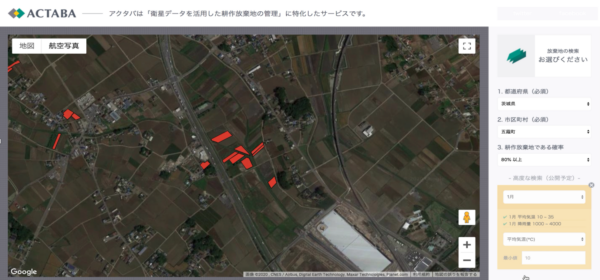
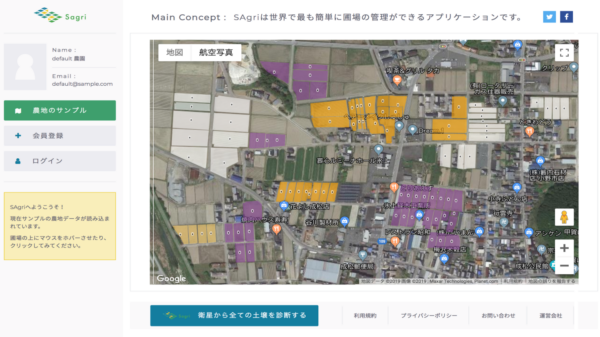
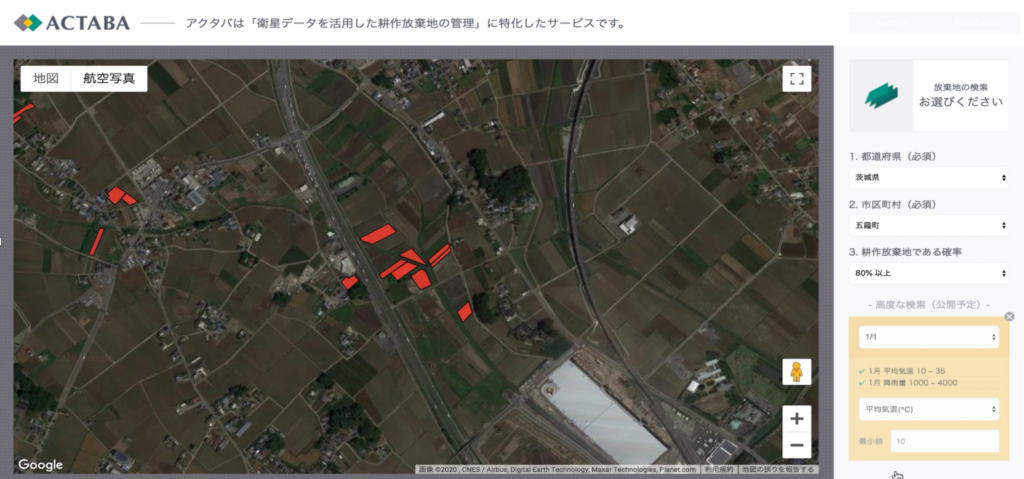
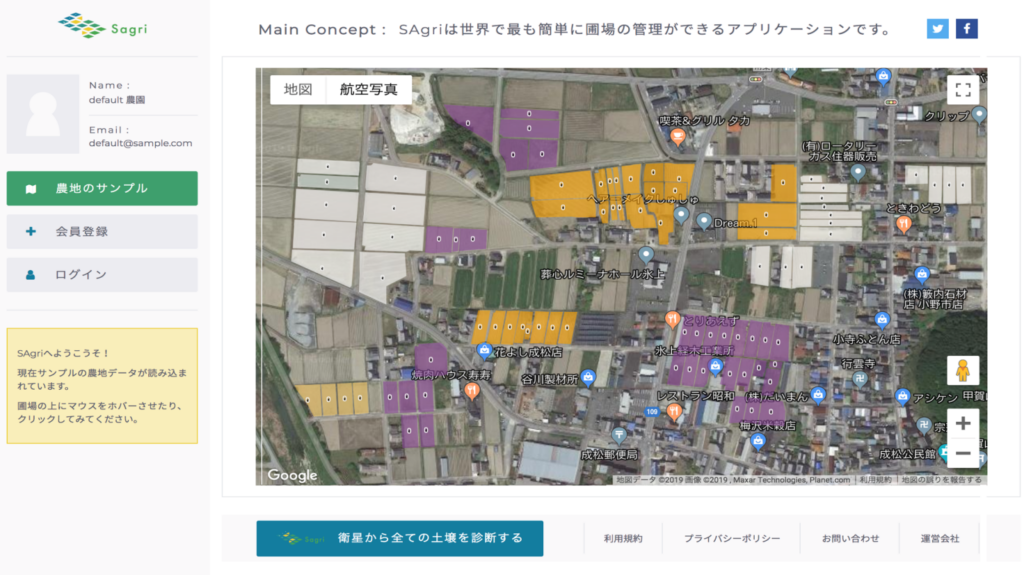
“Sagri’s strength is that we build a farmland database by combining farmland information, such as cultivated area, soil quality, and suitable crops, with land parcel data from satellites. By combining this data with IT, we can visualize indicators for each field, such as ‘this field grows such-and-such well’ or ‘such-and-such can be expected to yield a lot.’
Through a smartphone app called Sagri, we use the data to help each farm manage its daily work and provide information such as the timing of sowing and the right amount of fertilizer, which change with weather conditions and the state of the field, and sometimes information on things likely to affect crop growth, such as typhoons and droughts. Because our service uses open data such as satellite data and land information, another advantage is that it does not place a heavy cost burden on farmers,” Tsuboi says of the business. To add to that, the model of earning revenue through contracts with the Ministry of Agriculture, Forestry and Fisheries, local agricultural organizations, and agricultural corporations, rather than collecting app fees from individual farmers, is also a point not to be missed.
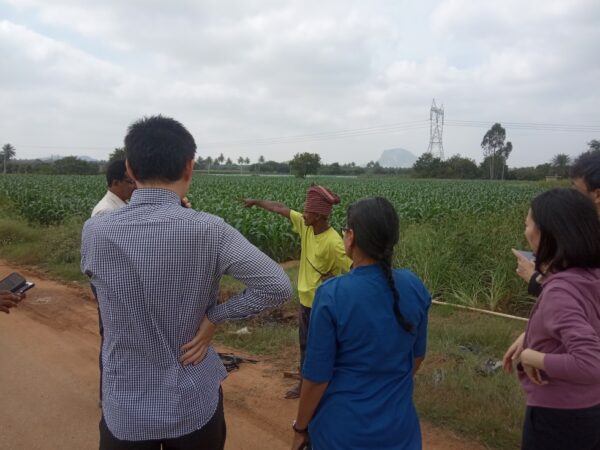
Another business, supporting connections between local farmers and financial institutions in India, is also steadily progressing. It assesses the creditworthiness that even individual farmers need to receive loans for running their farms from financial institutions. By quantifying the farmland, the types of crops that can be harvested, yield rates, and more with satellite data and showing profitability, financial institutions can lend with confidence: a system that benefits both sides.
With the wish to “create a society where children can speak proudly about their dreams”
How was the business idea connecting agriculture and satellites born? Behind it, Tsuboi says, are childhood dreams and formative experiences. “As a child, I was very interested in space and seriously wanted to build a space elevator when I grew up. I kept talking about that dream through junior high and high school, but my friends began talking about realistic dreams and goals, and adults scolded me to face reality…”
Tsuboi entered university with deep frustration that society had a climate in which such dreams were suppressed and could not even be spoken. Tsuboi did not give up studying space and satellites to fulfill that wish. At the same time, feeling that “a world where children cannot freely and directly talk about the dreams they want to fulfill is wrong,” Tsuboi started a company running space-themed study sessions for children.
What Tsuboi held in heart was the wish: “I want to convey the appeal of space to children. Above all, I want them to be free of the frameworks of adults and society, to freely say they love what they love, and to be able to call it their dream.” Working on these activities with like-minded peers, Tsuboi encountered agriculture. It was Tamba City that first provided a place for study sessions for children, such as outdoor rocket launch experiments and stargazing. While helping close educational gaps as part of Tamba City’s city promotion project, Tsuboi met farmers in Tamba City, got to know them, and came to see various challenges facing Japanese agriculture. Even then, various services to solve farmers’ problems were emerging, such as spraying pesticides by drone, turning farms into factories, and smart agriculture through mechanization, but there were many issues, such as high costs and difficulty introducing them.
“At university, I studied machinery and space, so I came up with the idea of combining satellite data made open in Japan and around the world with agriculture. So I founded Sagri with programmer friends in 2018, but at first things didn’t go well at all,” Tsuboi says. The company started with an app-centered core business, also aiming for global expansion, but because of aging farmers, barriers to bringing IT into agriculture, and a lack of IT literacy, the service did not spread in one leap.
Redesigning the business to fit India’s social conditions and farmers’ situation, very different from Japan’s
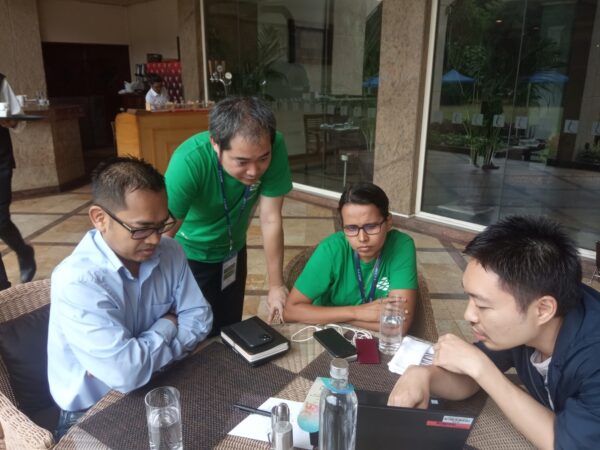
While steadily continuing activities in Japan, Tsuboi soon turned to the world and began acting on the global expansion envisioned from the start. But there was also the thought that simply rolling out the app-based agricultural support business from Japan overseas would be pointless. As if to clear away that uncertainty, Tsuboi went to India alone. “I had the feeling that no good ideas would come to me just thinking in Japan. So I went to India through connections from my previous work. In India, I focused on seeing farmers’ actual situation for three months. What I saw was a gap between the poor and the rich beyond anything imaginable in Japan. Farmers in particular were in a terrible state.”
What Tsuboi saw in India was that farmers could not get loans for the fertilizer, pesticides, and equipment needed to farm. Individual farmers in particular were poor, and the negative spiral of not being able to farm properly or grow their business for lack of funds was striking. Another thing Tsuboi felt was the sad reality that the children of these farmers had to help with the family farm rather than go to school, could not study properly, and found it hard to go on to university or elsewhere. In such circumstances, the children could not talk about dreams at all; they could only give them up. “To move the business forward in India, I felt we needed to redesign it. Specifically, to build a system that lets farmers become independent and escape poverty. Then farmers’ lives would become richer, and our business would be easier to advance. Above all, if farmers could escape poverty, their children could freely have dreams. With that in mind, I came up with and started working on our current microfinance business.”
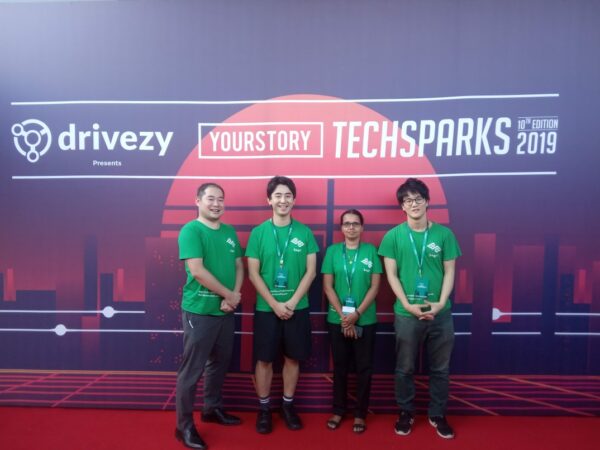
Having grasped farmers’ situation on site, Tsuboi teamed up with Indian government agencies, agricultural organizations like Japan’s JA, and foreign financial institutions to focus on supporting farmers. By matching soil diagnosis data with satellite data to evaluate farmland and providing the information to financial institutions, the company supports credit checks. By creating this system that lets institutions lend with confidence and improving the environment, it succeeded in creating a virtuous cycle in which farmers can get loans, raise farm income, improve their lives, and repay the loans. Creating one local success after another, the business in India continues to grow steadily.
Pressing ahead with a business that supports the world’s 2.5 billion farmers and creates happiness for as many people as possible
Sagri’s businesses in Japan and India are now expanding smoothly. In September 2019, in addition to being selected for the Tobidase Japan! subsidized demonstration project, the company established a local subsidiary, Sagri Bengaluru Private Limited, with the support of the Japan-India Startup Hub in Bengaluru, India, accelerating its business there. In December of that year, it was also selected for the “FY2019 Tellus Utilization Promotion Demonstration Project,” the “Tsukuba City Future Co-Creation Project,” and the “FY2019 Ibaraki Space Business Commercialization Demonstration Project,” and is taking part in demonstration trials with Tsukuba City to develop the space business. Its future growth is increasingly anticipated.
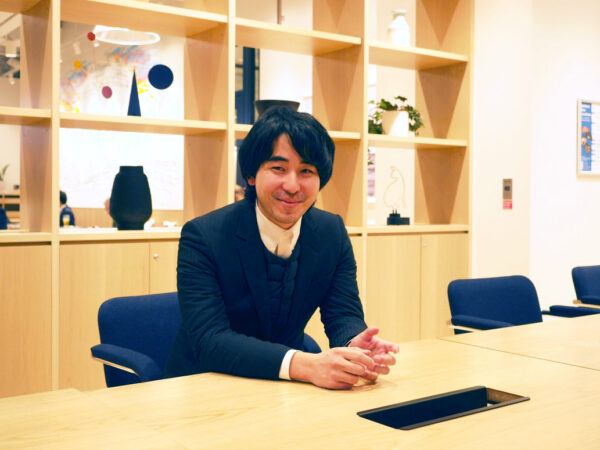
Tsuboi, busily traveling between Japan and India, finally told us: “Sales and profit are of course important, but for me, solving social problems is the most important thing for a company. In that sense, there are many agricultural fields where Sagri is needed, not only in Japan and India but in Asia, Africa, and more. Globally, the farming population is said to be 2.5 billion, so there is still endless work we can and should do. But once the current business becomes stronger, grows to the point where it can be entrusted to someone else, and becomes a standard, I am also prepared to step away from it cleanly. I myself want to value time with my family more than money, and above all I want to keep having dreams. So much so that after retiring, I want to go back to my university lab, where I am still enrolled, and research space. (laughs)” Those words conveyed not only the bright future of agriculture that Sagri will create, but also Tsuboi’s strong will as an entrepreneur, taking on dreams without wavering.
Interview date: January 17, 2020
(Interview and text: Manabu Kitagawa)