KURASERU, a matching app that closes the information gap and connects care facilities with people
Japan’s population is aging at a pace unmatched anywhere in the world. The population aged 65 and over now exceeds 35 million (*1), and in 2025, when all members of the baby-boom generation, the largest age group, will be 75 or older, Japan will enter the so-called “2025 problem,” with demand for medical and nursing care surging. Against this background, as is well known, the Ministry of Health, Labour and Welfare has set out to build a “community-based integrated care system” that lets older people live in their own way in familiar communities.
The “community-based integrated care system” the government envisions is one in which, led by local governments, medical, nursing care, and daily-life support organizations work together to create a comprehensive system of support and services in each community. In reality, however, cooperation between medical institutions and care facilities is not easy. On the contrary, the situation is growing more serious, and there is no end to tragic news such as suicides and murder-suicides caused by caregiving exhaustion and accidents in grueling care of older people by older people.
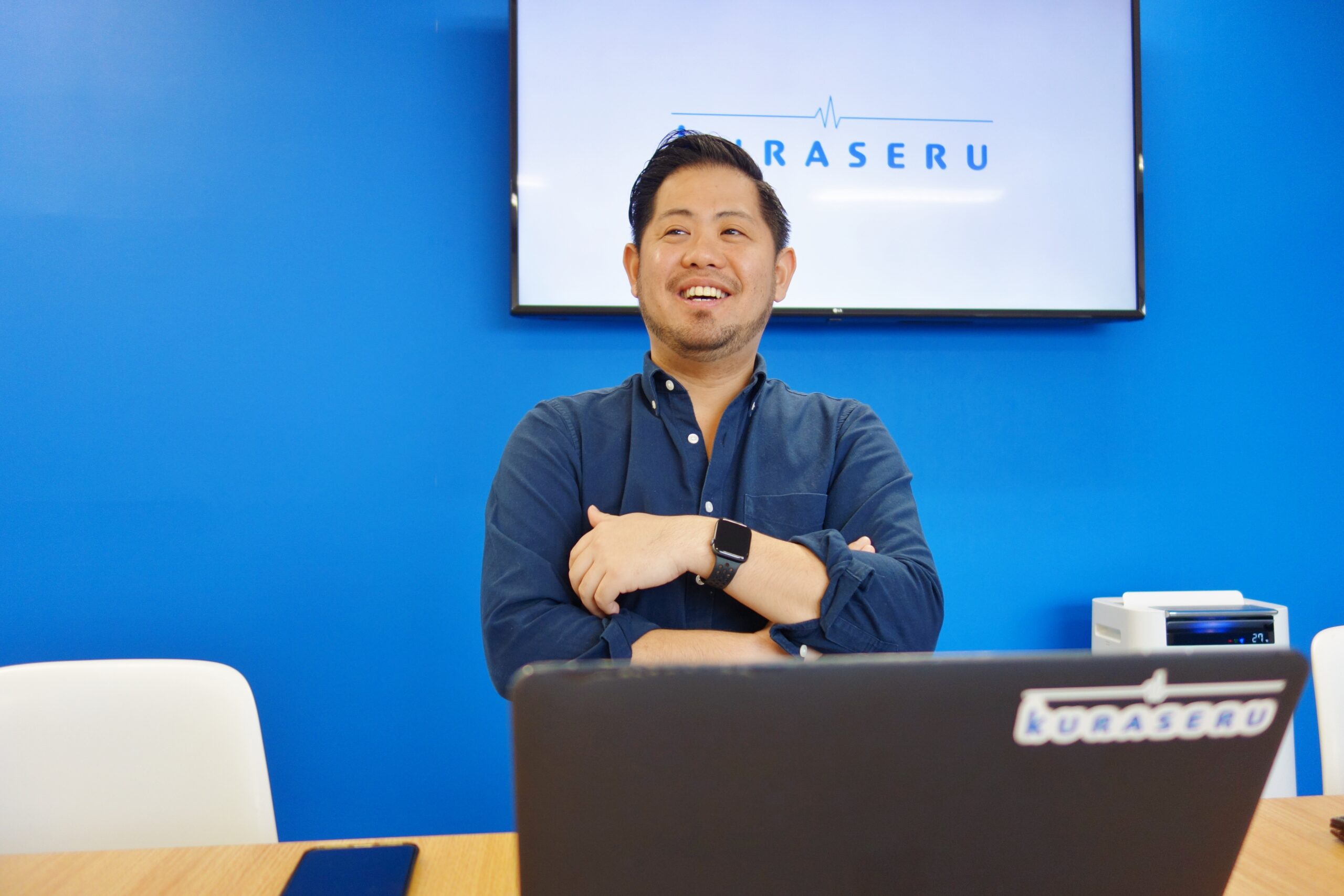
Daiki Kawahara, CEO of KURASERU, Inc., started KURASERU, a care facility matching service using IT, to solve these serious social problems in medical and nursing care settings.
Kawahara points out that “the biggest factor blocking cooperation between medical and nursing care is the information gap.” “In fact, information about care facilities depends on individuals. For example, when patients who need care after being discharged, or their families, look for a facility, individuals have almost no information about facilities, so they have no choice but to consult social workers or care managers. But the facility information each has varies by person. Social workers and care managers with only a little information cannot find places for patients to go or ways to handle things, leaving patients with nowhere to go and carrying a heavy burden.” Meanwhile, care facilities run a deficit unless their occupancy rate is over 90%, so busy staff also have to do sales, and they burn out and quit, accelerating labor shortages in a negative spiral.

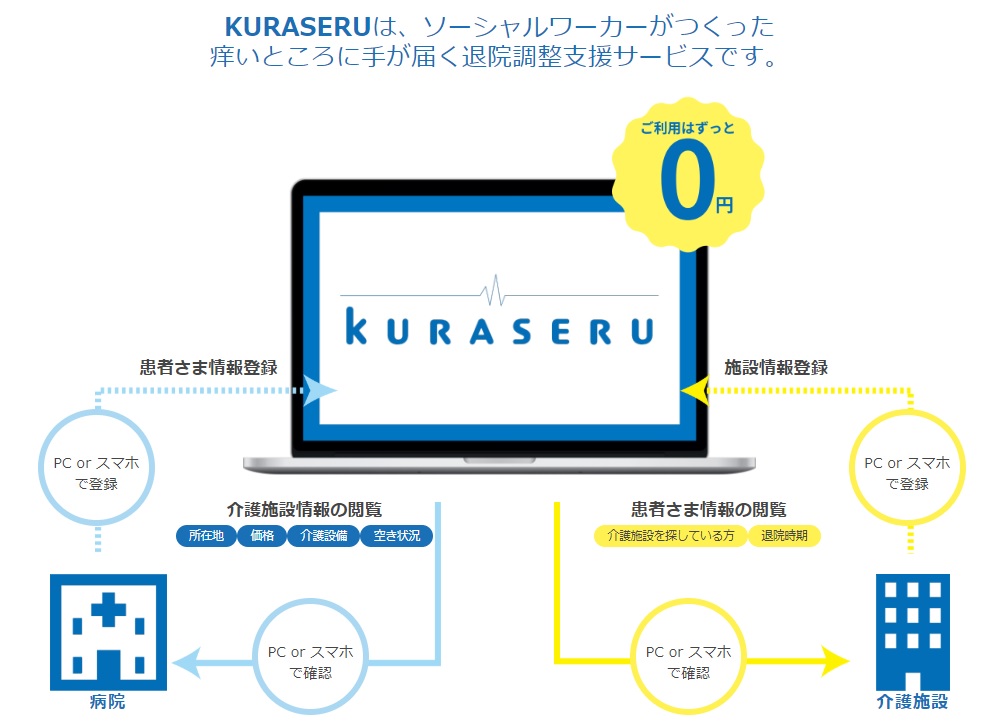
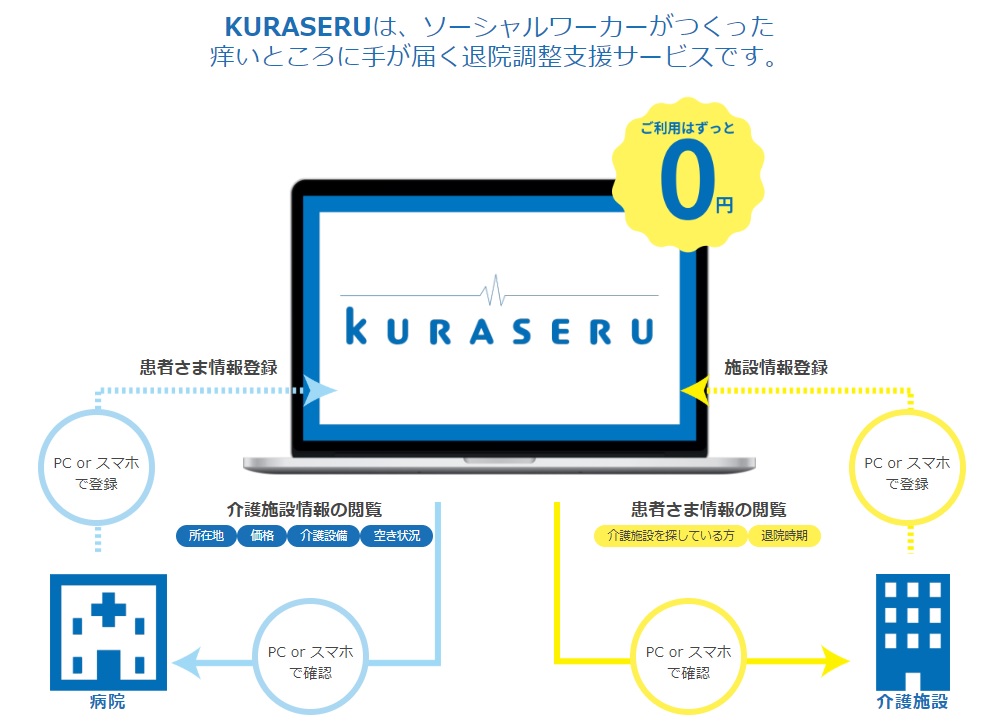
KURASERU is a groundbreaking system that solves the problems lying across medical and nursing care all at once, by turning individually held information into a database that both sides share. “What we aim for is ‘creating a world where everyone can live where they want to live.’ KURASERU is an information platform that properly connects medical care, nursing care, and the people who live with them to achieve that.”
Entering the world of medical and nursing care to compete in a big market with a promising future
Kawahara’s starting point goes back to the teenage years. Watching a father who ran a company, Kawahara decided to start a business too someday. “If I was going to do it, I wanted to compete in a big market with a promising future. That is why I set my sights on the medical and nursing care industry,” Kawahara recalls. To find business opportunities, Kawahara first interviewed care workers, but was told, “No one will take you seriously if you don’t know the field.” Resolved, Kawahara knocked on the door of a care facility the very next day and jumped into the industry, starting as a care worker, serving as a facility leader, and then becoming a social worker at a medical institution.
In 2016, Kawahara also started a home-visit nursing care company, building up all kinds of experience, knowledge, and personal networks in medical and nursing care. Through this, Kawahara became convinced of a real business opportunity. “Precisely because I threw myself into the field and knew the ‘reality,’ I could see the big problem of the information gap. And I thought that solving the problem at its root, rather than a service that takes measures in response to the demands of people and society, would have a bigger social impact and could generate more revenue,” says Kawahara.
At that point, the outline of KURASERU, a care facility matching service using IT, was already in Kawahara’s head. Kawahara reached out to a friend, Rui Hirayama (now Director, COO, and CTO), who had been active in the IT industry since university, and founded KURASERU, Inc. in October 2017. A big challenge connected to Japan’s future had begun.
Raising funds and taking on demonstration trials, and building the next business opportunity on the results
A major feature of KURASERU is that it is a B2B system. Its users are medical institutions and care facilities. For medical institutions, all registered care facility information and availability can be seen at a glance, so they can propose the best facility for discharged patients. For care facilities, there is no need to do sales blindly to raise occupancy, and when accepting patients from hospitals, they can communicate smoothly with the medical social worker in charge. It is a system that lets both sides cut the enormous time and effort they have spent until now.
“There have been websites introducing facilities to consumers, but when it comes to actually moving in, the patient’s health condition, medical history, medications, and treatment needed for daily life must be properly conveyed, and deciding on a suitable facility requires the judgment of doctors, care managers, and others. What matters is a tool that lets medical institutions and care facilities properly cooperate.” However, the early KURASERU was a web system, and Kawahara realized it was not being used much in the field.

“The social workers and care managers who actually use it are always on the move, and some hospitals, clinics, and facilities do not have PC environments. To make it fit their work better, we needed to develop a native app that could be used on portable devices. So I decided to raise funds first.”
Cooperation with the government is also key in medical and nursing care. In December 2017, Kawahara was selected for “KOBE Global Startup Gateway,” and in June 2018 for the OIH Seed Acceleration Program (5th cohort), building trust as a company. The company then raised 180 million yen and won the opportunity to run demonstration trials at medical institutions in Kobe.
“We distributed tablets free of charge to nine hospitals and first created an environment where they could use it as much as possible. The aim was to make it an essential tool in their daily work and then move to the next stage,” says Kawahara. Partly as a result, the number of registered patients grew from 800 to more than 4,000, and KURASERU made a big leap as a business.
From Kobe to all of Japan: all for people’s healthy, better lives

Kawahara’s challenge to solve problems in medical and nursing care will continue. “Building on our success in Kobe, we want to expand ‘a world where everyone can live where they want to live’ to Osaka next, and then all of Japan,” Kawahara says, eager about the outlook. Kawahara’s vision casts a ray of light on Japan’s increasingly serious aging society and care problems. The new social system coming from Kobe will surely change Japan’s future for the better.
Interview date: December 5, 2019
(Interview and text: Mitsuko Yamashita)