
Keito Takishita

An AI platform that lets robots read their surroundings from camera images, learn, and move

A navigation model that lets robots move autonomously, safely and smoothly

Keito Takishita

Kanaria Tech Inc.

Position
Representative Director and COO
Website
https://www.kanaria.tech/ja (opens an external site in a new tab)
Business
Development of KRM (Kanaria Robotic Model), a foundational AI model that enables robots to move, adapt, and learn socially

Kanaria Tech Inc. (Kanaria Tech) develops KRM (Kanaria Robotic Model), a proprietary navigation model that lets robots read and adapt to their surroundings from camera images and learn on their own. It is a university-born AI startup founded by a team of three led by current students of Ritsumeikan University. COO Keito Takishita, who says the company has signed a partnership with a major Japanese robotics company and is running demonstration trials not only on the university’s campus but in a variety of environments, talks about the journey so far and the outlook ahead.

An AI platform that acts as a robot’s “eyes” and “brain”

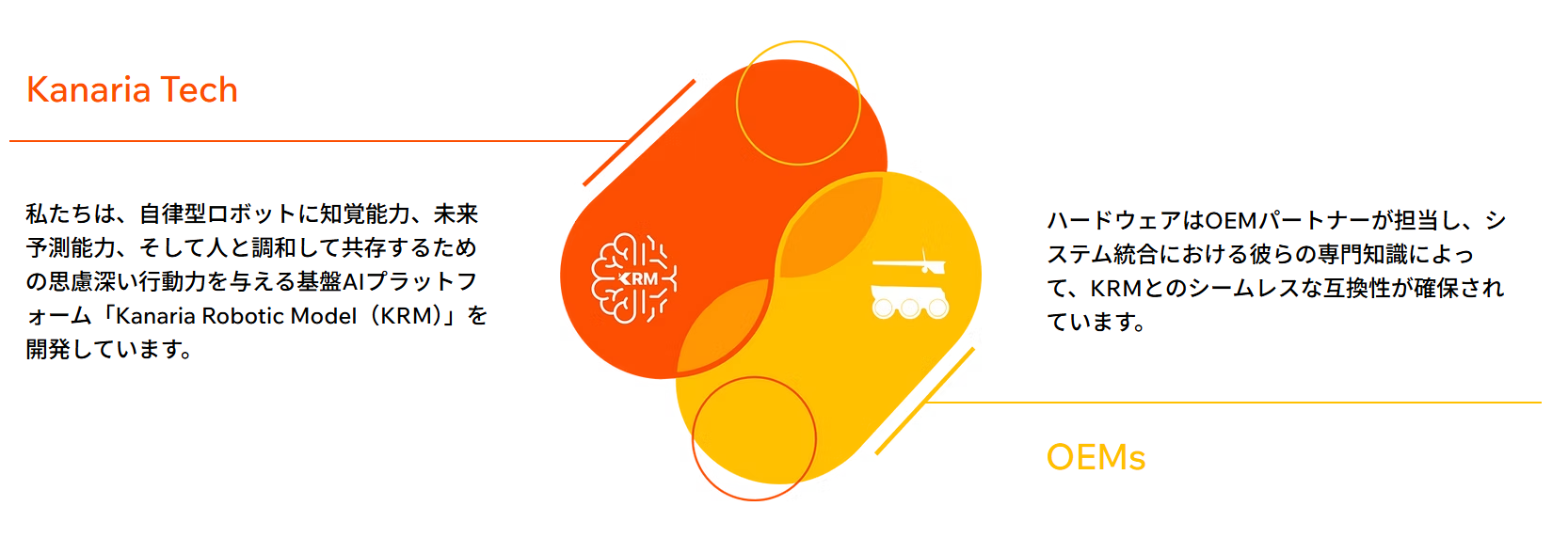
The KRM we are developing is an AI platform with a camera that serves as a person’s “eyes” and a “brain” that learns from the camera’s images, enabling robots that move naturally while understanding their surroundings, just as people do. The system is highly versatile and can be retrofitted to all kinds of robots, regardless of the manufacturer.

Kanaria Tech Inc.

Conventional robot navigation technology creates a map of the area and has the robot recognize its own position and obstacles with multiple on-board sensors. With this method, however, mapping takes a lot of work over wide areas, and the map has to be redone every time the layout of the area changes. In addition, using multiple sensors at once inevitably causes discrepancies in the data, and those discrepancies have been a major obstacle to letting robots learn on their own. For these reasons, running robots in wide areas, in places where the environment changes easily, and in places with heavy foot traffic has been very difficult.

Robots equipped with our KRM see obstacles and people with their “eyes” and recognize their movement, speed, size, and shape in real time. They then predict what will happen next and act accordingly. This lets them move smoothly even in wide, complex areas and in crowds, where robots have been considered hard to deploy.

This technology is currently patent pending. With investment from the Ritsumeikan Social Impact Fund (RSIF), the Ritsumeikan Trust’s startup support fund, and with support from programs such as NVIDIA Inception and the Google for Startups Cloud Program, we are steadily moving toward putting it into use in society.

Founding a company with fellow international researchers who share the same vision

Movies got me interested in robots, and I was entering robot competitions from elementary school. I wanted to go to a university overseas and study robotics and AI while learning English, but I had to give up on applying to universities abroad because of the COVID-19 pandemic. Instead, I entered the Information Systems Science and Engineering Course (ISSE) at Ritsumeikan University’s College of Information Science and Engineering.

I learned English while studying in an environment where most of the students were international students, and in my second year I took part in a NASA program, winning a prize in a Mars rover development contest there.

Those experiences led me to think about starting a business in AI and robotics. Around that time, I hit it off with Ibrahim (now CEO), from Turkey, who studied in the same lab, and Ibrahim’s friend Alisher (now CTO), from Kyrgyzstan. We founded Kanaria Tech together in 2022 with a vision: “We want to build robots that can move like people, even in places where people come and go.” The name comes from the fact that “canary,” the bird, is pronounced “Ka-na-ri-a” in all three of our native languages, and from our hope to be a company that opens up unknown territory, like a canary flying through a cave no one has ever entered.

We believed that to build robots that move like people, we first had to change conventional navigation methods. The method used for robot navigation until then was to give the robot detailed rules one by one, such as [go on a green light] and [stop if a person is in front]. On real streets, however, contradictory situations such as [the light is green, but there is a person in front] happen often, and each time the robot could not decide what to do and its movement became unstable.

So we took a different approach: we give the robot no rules at all. Instead, we mount a camera on it, drive it manually, and teach it the footage as correct navigation. By having it learn from a wide range of video data, the robot became able to make decisions that properly take the situation into account, for example when the light is green but a person is in front.

This is the same cognitive and behavioral process that we humans follow naturally (seeing with our eyes, judging with our brain, and acting). We are the first in the world to apply it to robots. We are convinced it is a big step toward bringing robots closer to humans.

Developing technology around the principle that “human dignity” comes first

Our goal is “a society in which robots blend naturally into everyday spaces and work there.” By making KRM a foundational technology that can be installed in any robot, we aim to lower the cost of adoption and build a society in which everyone can benefit from robots. Examples include easing labor shortages at social infrastructure sites that are becoming hard to maintain as society ages, and improving service quality and operational efficiency in places where people gather, such as commercial facilities and tourist spots.

We currently have 15 employees. Everyone except me is a foreign national, and with that international makeup as our strength, we aim to expand into global markets in Asia, Europe, North America, and elsewhere, and grow KRM into the world’s standard navigation platform.

Kanaria Tech Inc.
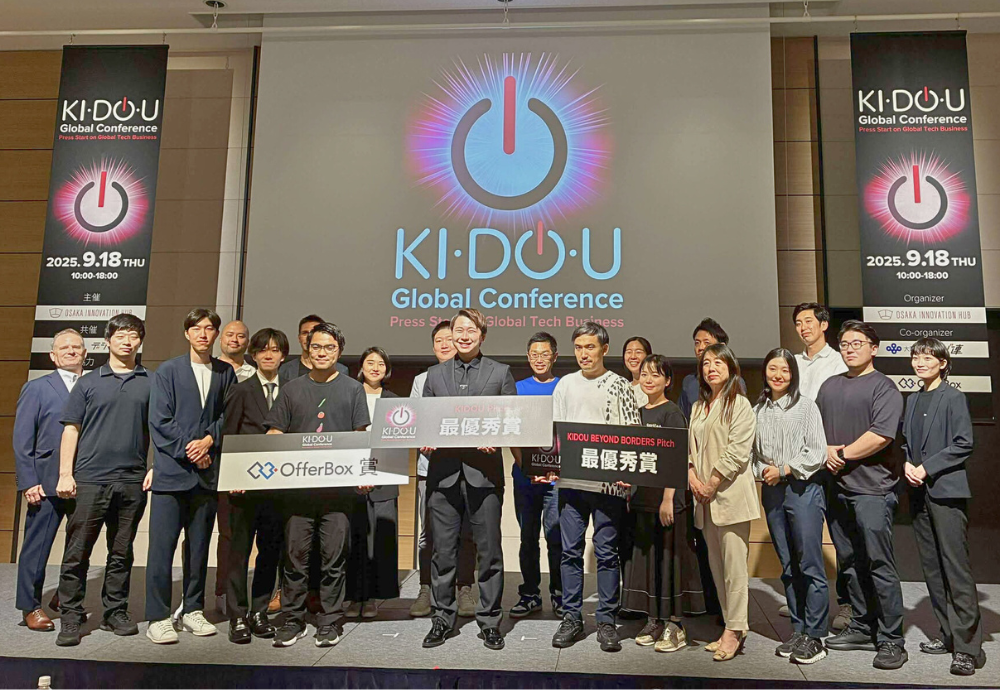
In September 2025, the team won the top prize in the pitch contest at “KIDOU Global Conference”

That said, we do not think robots and AI can fully replace people. No matter how far the technology advances, robots are there to support people’s lives. The idea of “putting human dignity first” is always on our minds as a principle we will never compromise on in development.

We are currently running proofs of concept with partner companies toward real-world operation. For example, we are conducting demonstration trials with NSK Ltd. at Ritsumeikan University’s Osaka Ibaraki Campus, with KRM installed on the company’s autonomous mobile robot.

Going forward, we want to connect with many more partner companies and make KRM more adaptable through testing in diverse environments. We hope to work with robotics companies not only in Japan but around the world, and to contribute to the growth of the robotics industry and the creation of new value.

How We Used OIH

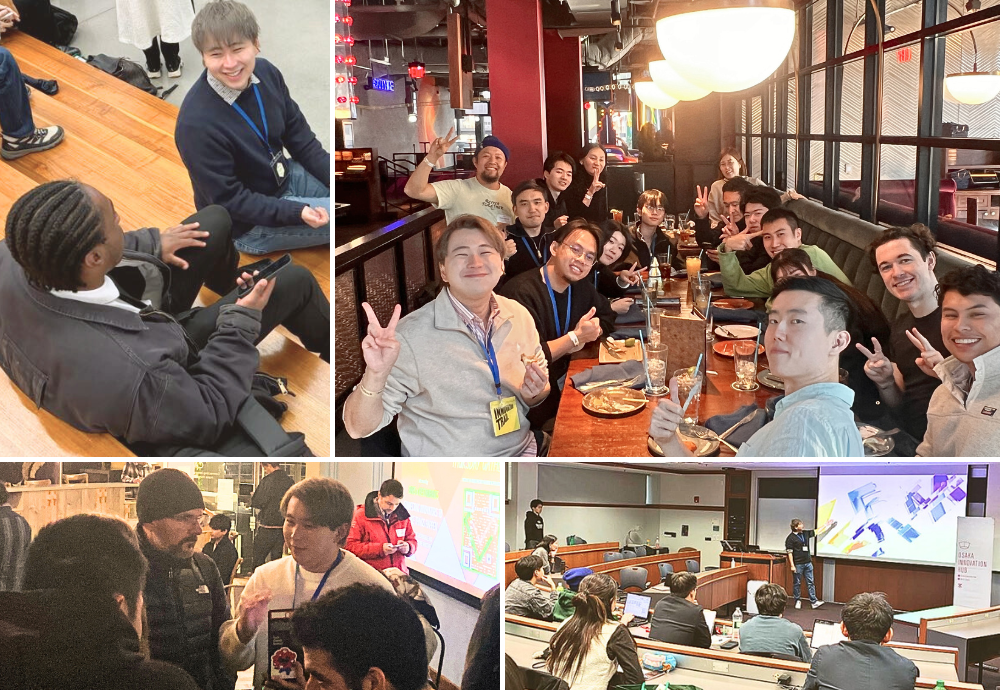
At “KIDOU Global Conference” held in September 2025, we won the top prize in the KIDOU Pitch category. Then in November of that year, I joined the overseas workshop “Global Entrepreneur Program” and visited Boston in the United States, which was very inspiring. Through OIH’s programs, I have been able to meet people who share the same ambitions, not only in Kansai but from all over Japan and around the world.

Kanaria Tech Inc.
In November 2025, the team joined the OIH overseas workshop “Global Entrepreneur Program”, gave an English pitch at Babson College, and deepened ties with local students, faculty, and support organizations

Interview date: December 12, 2025
(Interview and text: Aya Iwamura)