
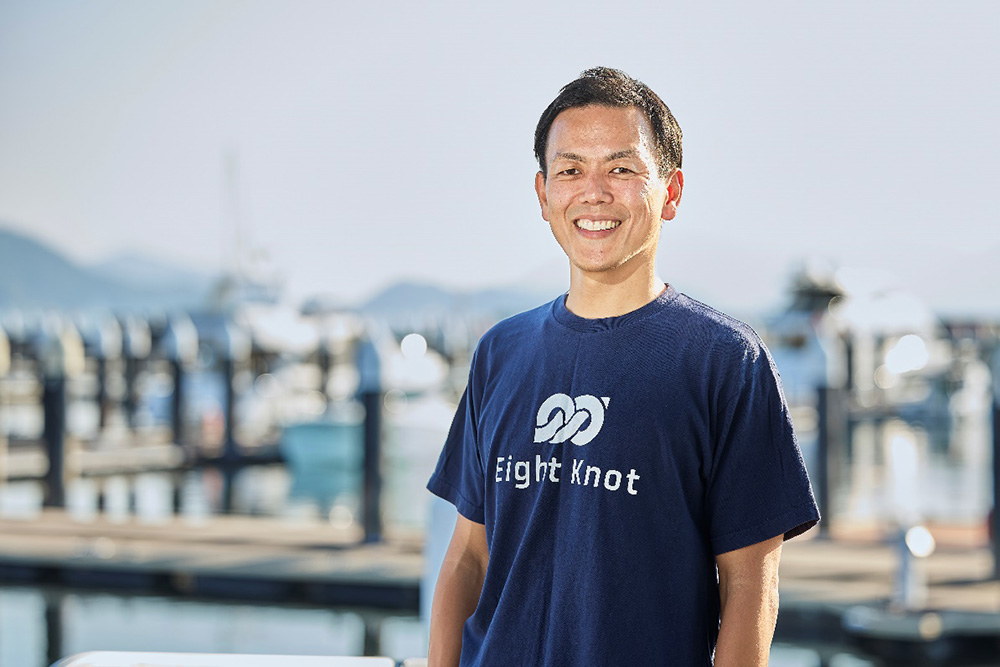
Eight Knot Inc. (Eight Knot) has been developing autonomous navigation technology for small vessels. CEO Yujin Kimura says that achieving unmanned navigation in the future with the autonomous navigation platform Eight Knot AI CAPTAIN (AI CAPTAIN) should solve many social issues that remote islands face, such as depopulation and aging. We spoke with Kimura, who wants to spread AI CAPTAIN to build a society where everyone can enjoy freedom of where to live and how to travel, and to make the sea even safer.
AI assists with ship handling, which requires seasoned skill
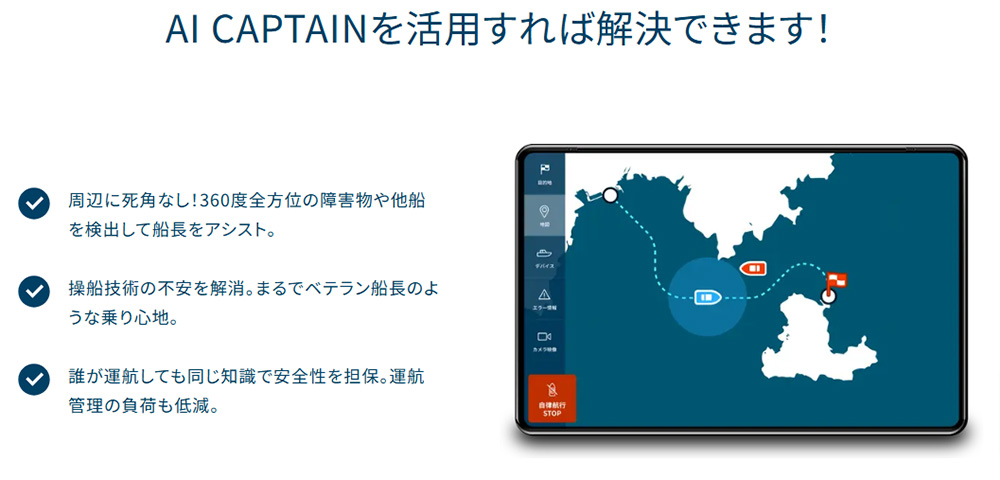
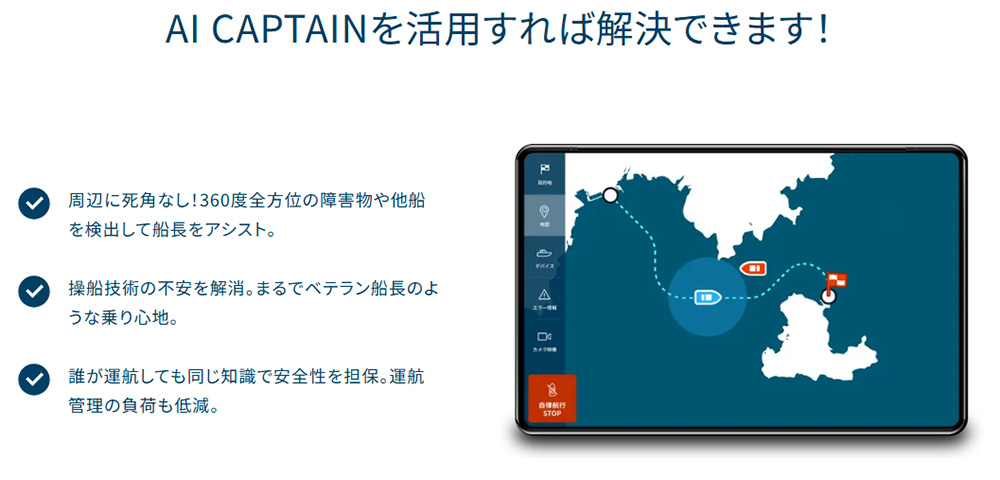
The service we provide is AI CAPTAIN, an autonomous navigation platform for small vessels. Just set a destination on a tablet installed in the wheelhouse, and the AI generates the best route and navigates safely while detecting other vessels and obstacles with sensors. The AI also provides appropriate assistance, depending on the situation, with berthing and unberthing, which require especially advanced ship-handling skills.
*Click the image to view it larger.
(Source: Eight Knot website)
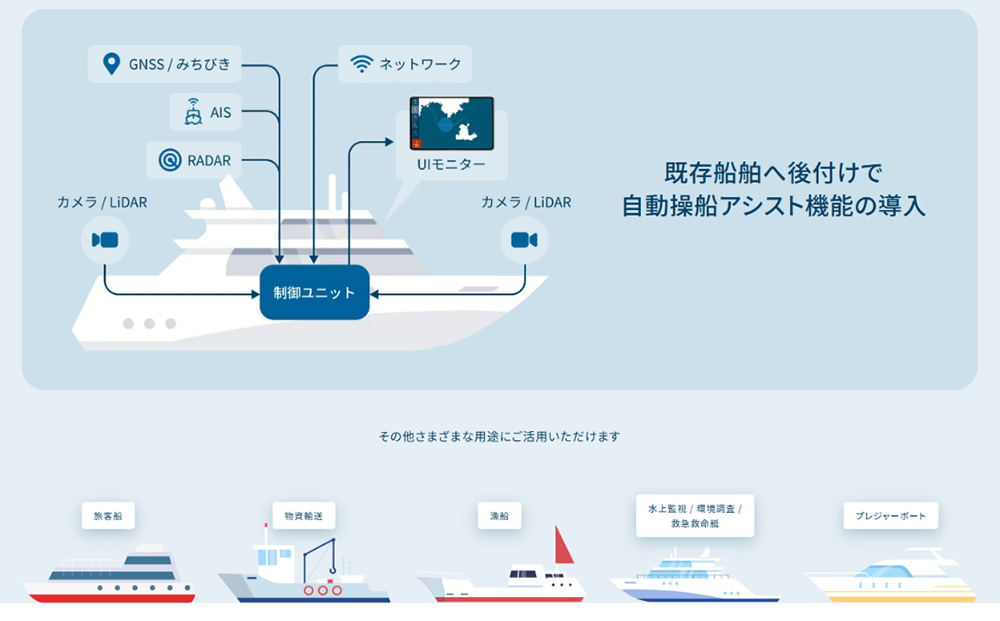
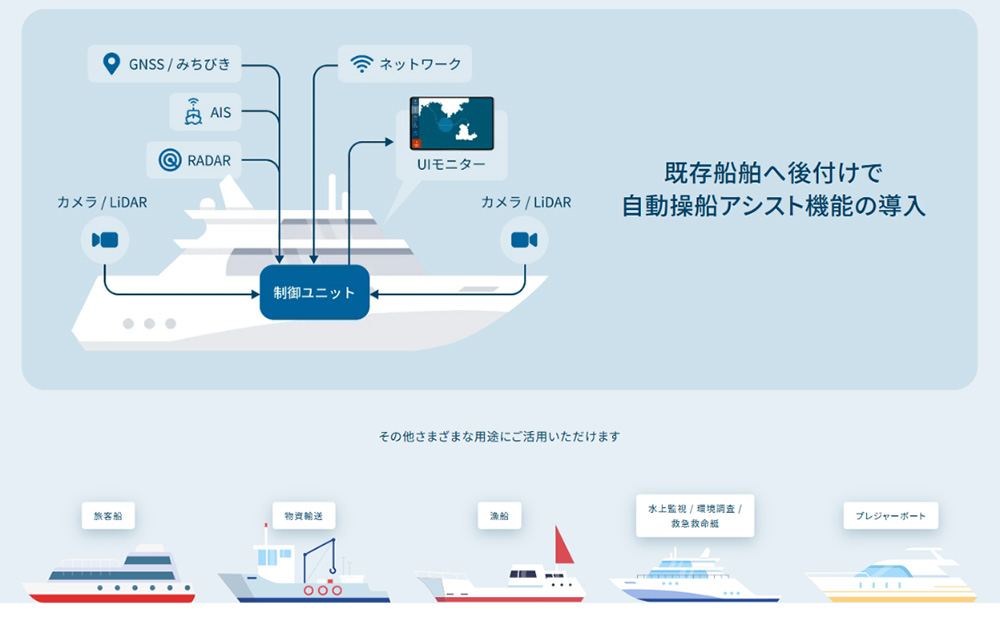
A feature of AI CAPTAIN is its versatility: it can be installed on almost any small vessel under 19 tons. It can be retrofitted to many kinds of vessels, including fishing boats, pleasure boats, passenger ships, cargo ships, work boats, and rescue boats, and they can start navigating autonomously right away.
*Click the image to view it larger.
(Source: Eight Knot website)
For land mobility such as passenger cars, new autonomous driving assistance functions are being developed one after another, such as adjusting the distance to the car ahead with ACC (adaptive cruise control) and driving at a constant speed.
For ships, however, such technology has hardly been developed until now. Navigating a ship still requires craftsman-like skill, and it takes years to become a full-fledged crew member or captain. In terms of safety, too, navigation varies depending on the career and skill level of the captain and crew.
By supporting ship handling, which has required seasoned skill, with the power of a system, we believe AI CAPTAIN can help improve navigation safety and ease the shortage of crew.
Learning how hard ship handling is, and realizing the state of watercraft technology
I love marine sports and got a boat license when I was young. The first time I rented a boat and went fishing at sea with friends, handling the boat was much harder than I expected. I was so preoccupied with it that I could not enjoy being on the sea, let alone fishing.
It is easy to understand if you compare it with driving a car. Because of wind, waves, and currents, a boat cannot go perfectly straight, and it cannot stop completely even when you try to brake. On top of that, there are no markers at sea like the signs and white lines set by road traffic law, so you get a sense completely different from operating land vehicles: where am I, which way am I heading, how far am I from the boats around me? In other words, it takes considerable experience and training to handle a boat freely.
That was when I noticed the fact that “while AI-powered autonomous driving assistance for cars and other land mobility keeps evolving, assistance technology for marine mobility has hardly been researched or developed,” and I began to see it as a problem. I thought that, drawing on my career in robot development, I might be able to update ship-handling skills with AI technology, and that this could lead to solving many social issues.
Solving the challenges of remote islands through autonomous ferries
One of the social issues we are focusing on now is remote island routes. Japan, an island nation, has more than 400 inhabited remote islands (*1), of which more than 300 are not connected to the mainland by bridges. These islands are linked by ferries, but more than a third of the routes run at a loss (*2), and many ferries depend on subsidies from the national and local governments.
*1 Source: Ministry of Land, Infrastructure, Transport and Tourism, 2024, “Composition of Japan’s Islands” (in Japanese)
*2 Source: Ministry of Land, Infrastructure, Transport and Tourism, 2008, “Study Group on Improving the Remote Island Route Subsidy System” (in Japanese), “1. Status of Subsidized Routes 1-4”
Although these routes are essential infrastructure for the lives of island residents, some are being reorganized, reduced, or even discontinued, and they are clearly not sustainable. As we interviewed people living on remote islands, we saw the reality that their whole lives are constantly constrained by transportation, and they cannot even go where they want, when they want.
In this situation, many young people leave the islands, ferry ridership falls, and in a vicious circle, services are cut and fares go up. The financial burden on island residents is also growing.
Autonomous navigation with AI CAPTAIN can solve many of these challenges that remote islands face. First, if navigation assistance reduces the burden on crew and captains, the problems of recruiting and retaining crew will improve, and more sailings become possible. As the movement of people and goods becomes more active, costs such as fares and shipping fees should also improve. If island life becomes more convenient, more people will want to move to remote islands with better environments, and the islands will become livelier. More tourists will come from Japan and abroad as well.
We are currently running demonstration trials of autonomous vessels equipped with AI CAPTAIN, mainly around remote islands in the Seto Inland Sea. In January 2025, on the route between Osakikamijima Island and Takehara Port in Hiroshima Prefecture, trial operation of a smart water bus began at night and in the early morning, when the ferry does not run. I hope island residents will feel that island life is going to become more convenient.
Our goal for the future is unmanned navigation: a service that lets you call a boat from an app on your phone at any time, like a taxi, and go wherever you want. If this comes true, we will achieve a world where people can truly live wherever they want and go wherever they want. We want to support, through watercraft, this right that everyone should be able to enjoy. As a pioneer in autonomous navigation technology, we will keep working hard.
How We Used OIH
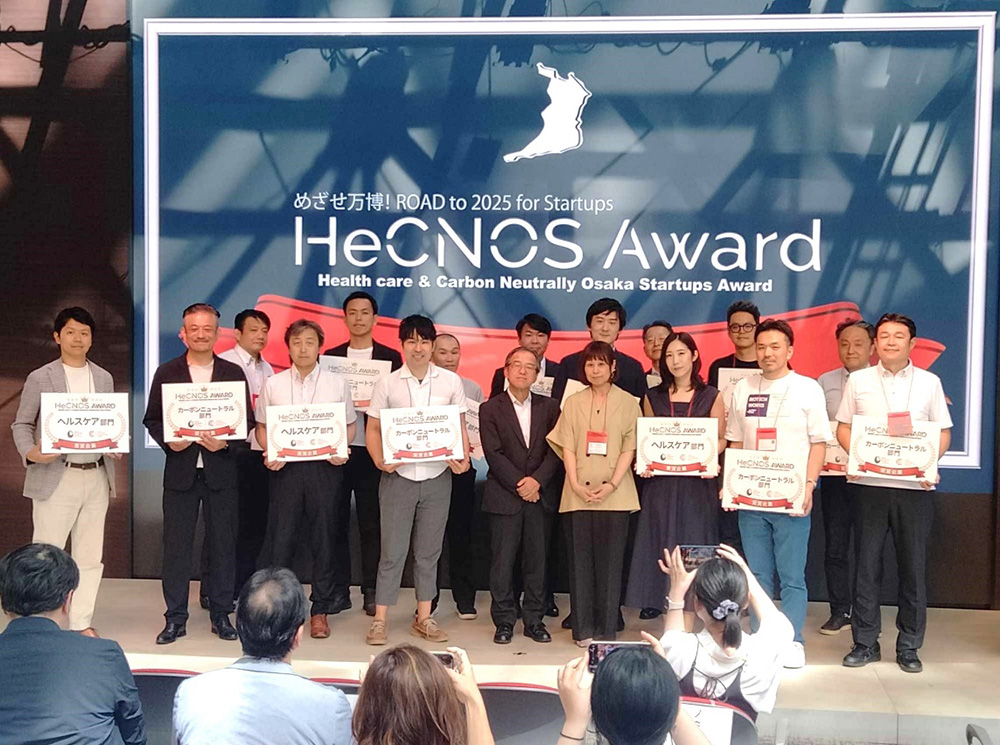
We are expanding overseas by entering the US pleasure boat market. While we were looking to raise our profile for that, at the 2nd HeCNOS AWARD, we won an award in the carbon-neutral category and were given the opportunity to exhibit at the Osaka Healthcare Pavilion at Expo 2025 Osaka, Kansai, Japan. Through OIH, our connections with people and our chances to take part in events kept growing.
Interview date: January 15, 2025
(Interview and text: Aya Iwamura)