

Sharing information in many languages just by scanning a QR code
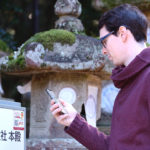
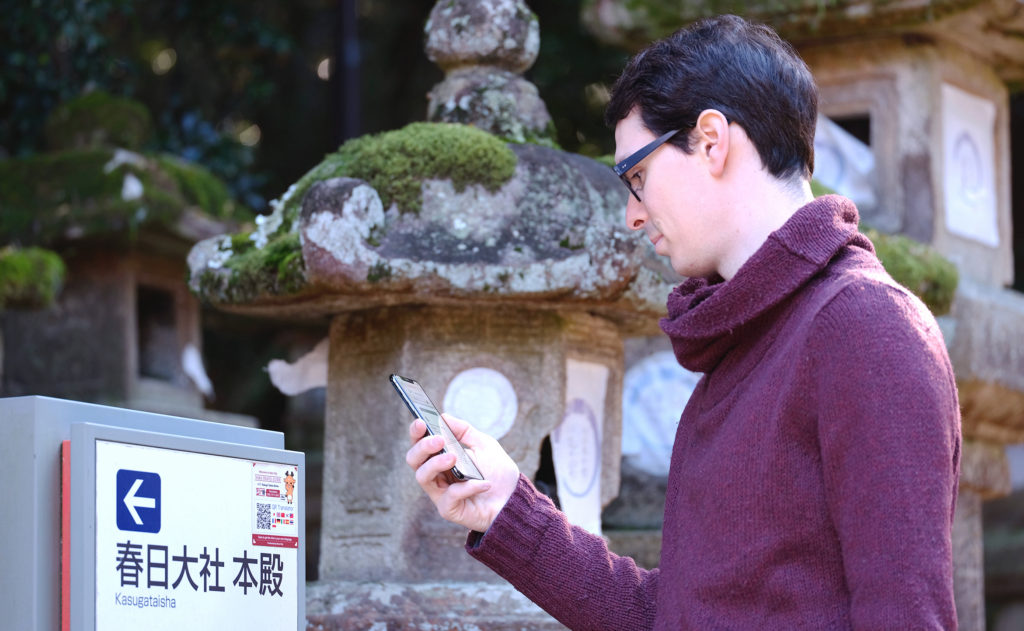
QR Translator, developed by PIJIN Co., Ltd., is the world’s first solution for providing useful information to foreign visitors in many languages. When users scan a QR code attached to signs or printed materials at tourist sites, stations, airports, and elsewhere with a smartphone, the information is displayed in the user’s language: a very handy tool. The business started in 2011 after the system obtained a business method patent in Japan. It now supports 39 languages, including English, German, French, Chinese, and Korean. “Because it uses the smartphone’s browser, users do not need to download an app and can use it easily. Meanwhile, providers have no app update management costs and can keep the translation, production, and printing costs of multilingual materials down. It is effective in areas with many inbound tourists or foreign residents moving in,” says Representative Director Kyosuke Matsumoto.
Adoption spreading in tourism, government services, transportation, and more
QR Translator is being adopted in more and more fields: tourist information and government services of local governments across Japan, including Nara City and Izumisano City in Kansai, the Tokyo area, Hiroshima, Ehime, and Tohoku, as well as public transportation, shrines and temples, exhibition facilities, and product displays and packaging. At Fushimi Inari Shrine in Kyoto, for example, QR codes on signs at each spot in the grounds provide guidance with multilingual text and audio guides. At Kifune Shrine, the results of water fortune slips, whose fortunes appear when dipped in sacred water, are provided in English, Simplified Chinese, Traditional Chinese, and Korean as well as Japanese. Among new facilities, it has reportedly been adopted for the in-house leaflets of JO-TERRACE OSAKA and MIRAIZA OSAKA-JO at Osaka Castle and for the Osaka Castle Park guidebook.
The company also provides information for foreign visitors with disabilities using sound and light, for example by linking with Yamaha’s Omotenashi Guide, which makes audio information such as announcements multilingual, for people with visual impairments, and by working to link with systems that share information visually through lighting for people with hearing impairments. It has also just released an image recognition system using posters that can be read even from a little distance away. By adopting various methods, it aims for a service that can reach as close to 100% of people as possible.
Sharing disaster information along with tourist information to give foreign visitors peace of mind
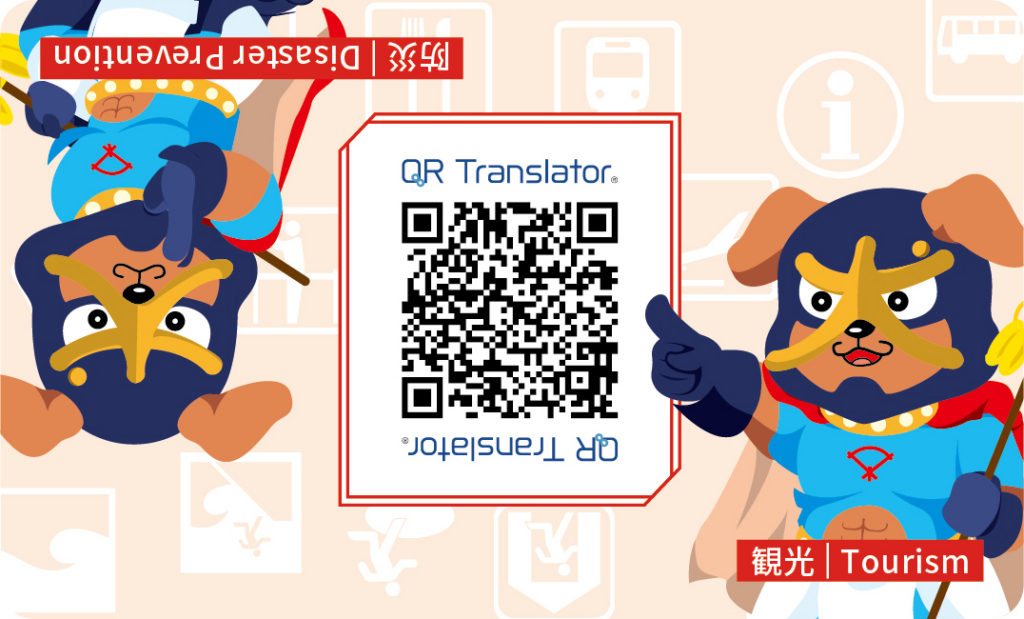
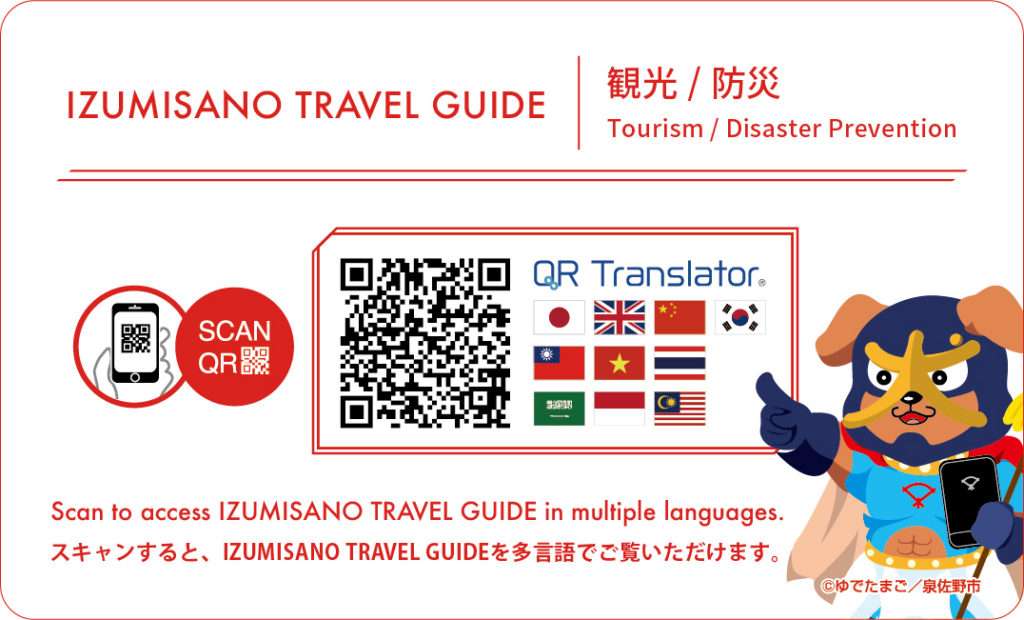
In addition to tourism and government information services like these, QR Translator has also started providing disaster information. Right after the Kumamoto earthquake, people there asked whether it could be applied to sharing disaster information with foreigners, and through the IoT Acceleration Lab of the Ministry of Economy, Trade and Industry, the company joined a consortium of the National Research Institute for Earth Science and Disaster Resilience and has been advancing research and development. The company’s disaster information system shares facility and tourist information on the web in many languages, and, linked with J-Alert and L-Alert, displays warnings when an earthquake occurs, so that pointing tools and audio guidance make it instantly clear “what to do now” and “where to evacuate.” Izumisano City in Osaka has decided to adopt the company’s system, ahead of the rest of Japan. QR codes are posted on notice boards at major stations and tourist information centers and in tourist leaflets, sharing information such as what to do in a disaster and emergency hazard maps, along with tourist information, in many languages.
Although this is useful information, Matsumoto says introducing it to local governments involves many difficulties.
“When local governments introduce disaster information systems, they invest hundreds of millions of yen in equipment such as large servers, yet in most cases there is no way for residents to receive that information. Our QR Translator is software only, so it can be introduced for a few million yen, and we propose that the money saved by moving to the cloud be shifted to evacuation drills and awareness activities to raise foreigners’ disaster awareness. On the other hand, we are sometimes asked whether they should spend more of the budget on information for foreigners than for Japanese people. So we signed a partnership agreement with Yokohama City, and we raise funds in cooperation with private companies to develop web apps with QR Translator, promoting everything from livening up tourism to providing disaster information. I think this can be rolled out as an effective approach for local governments in urban areas.”
Last fiscal year, the company was also commissioned by the Fire and Disaster Management Agency to run a demonstration of evacuation drills for foreigners, and based on the results, contributed to creating evacuation guidance guidelines for stations, airports, stadiums, lodging facilities, and more. The policy is to use them to guide foreigners in evacuations ahead of the Rugby World Cup and the Olympic and Paralympic Games. Changing awareness of disaster preparedness nationwide is the challenge ahead.
Shifting from a hardware focus to a software focus to lower social costs
President Matsumoto started a venture while at Kwansei Gakuin University and worked on urban planning consulting. Having experience negotiating with local governments on community development, Matsumoto was invited by a former university professor who was an executive at PIJIN and began supporting sales from outside the company. “At the time, the QR Translator service had just been created, and sales were just getting started. I did sales to local governments and fed back customers’ comments and our own impressions from using it, upgrading its functions. When this sales work had increased the number of adoptions, in 2016, I was given the opportunity to become president.”
Alongside work, Matsumoto has lectured at Kwansei Gakuin, the alma mater, for more than 10 years, and as life work volunteers with students on a project to revitalize the Kotoen area, where the Nishinomiya campus is located. Matsumoto also teaches as a visiting associate professor at the University of Hyogo Graduate School.
“Since starting a venture as a student, I have seen my work as social business. I define social business as lowering social costs, and I want QR Translator to change society’s direction from a hardware focus to a software focus and return the costs saved to things such as revitalizing communities. And I want to build a phase-free society where foreigners and people with disabilities are not left behind, whether in normal times or emergencies,” Matsumoto says of the ideal society. The goals ahead, Matsumoto told us, are to further increase adoptions in Japan and to scale up the business through overseas expansion.
“QR Translator has business method patents in Japan, the United States, Russia, China, and Hong Kong. It can be rolled out overseas in the same way as in Japan, so we want to spread the system by working with local partner companies. We would like to start with Southeast Asia, which has a strong affinity with Japan.” Matsumoto is eager to take on the challenge with the world as the business field and listing as a goal. That gaze is fixed firmly on the future.

Interview date: August 13, 2018
(Interview and text: Isshin Ohashi)